
FINANCIAL REPORTING FOR AIRLINE CREW TRAVEL
Financial control for every crew-travel dollar.
Routespring gives airline Finance, Procurement, and Operations one reporting layer for program spend, cost per room night, contract utilization, operational-change cost, booking-card-folio reconciliation, open exceptions, measured savings, and supplier performance.
THE FINANCE GAP
Operations move in real time. Financial answers arrive later.
Crew-travel cost changes with the operation. When the financial story is spread across separate reports, teams spend valuable time rebuilding context before they can explain movement, investigate exceptions, or defend value.
Slow answers
Finance waits for multiple reports before it can explain the program's true position.
Unexplained movement
Operational changes affect cost, but the reason is often separated from the financial result.
Manual investigation
Teams spend too much time gathering evidence before they can resolve an exception.
Value without proof
Savings and supplier performance are difficult to defend when they are measured in different places.
ONE FINANCIAL VIEW
Move from totals to decisions.
Routespring connects the financial result to the operational context behind it, so each team can act from the same version of the truth.
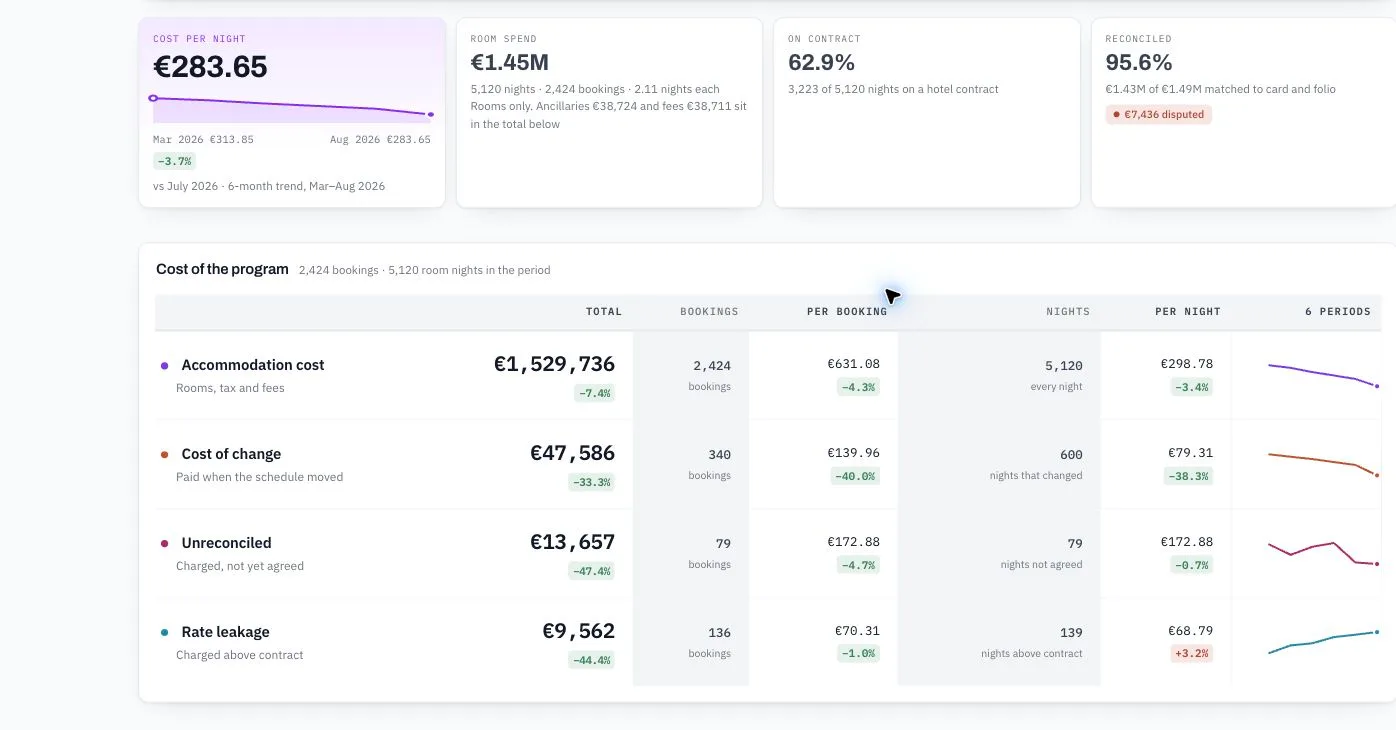
01 / CONTROL PROGRAM SPEND
Track program spend, unit cost, contract utilization, and financial status.
See total crew accommodation spend in dollars, cost per booking and room night, period-over-period movement, the share of nights placed on contract, and the amount reconciled or disputed.
Program spend
Total accommodation cost, cost of schedule changes, unreconciled value, and rate leakage.
Unit-cost movement
Cost per booking and cost per room night, with period-over-period and six-period trends.
Contract utilization
Room nights placed through contracted hotels versus bed-bank, GDS, and last-room channels.
Financial status
Reconciled value, disputed value, and items still requiring finance review.
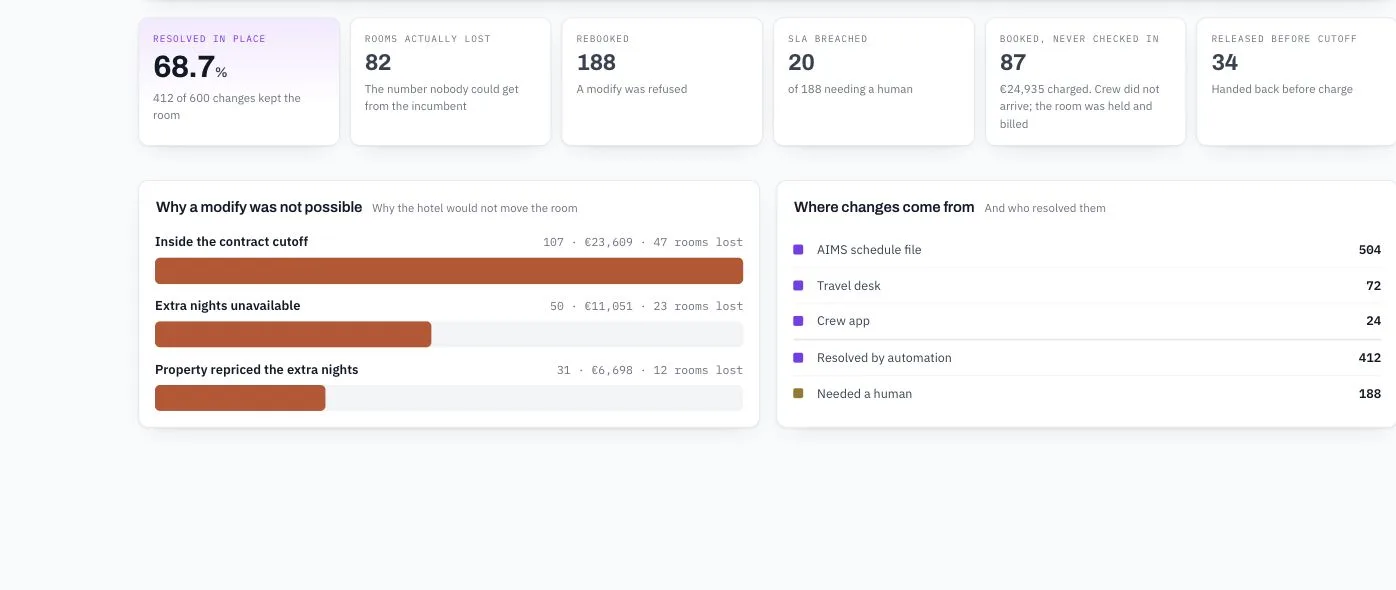
02 / EXPLAIN OPERATIONAL COST
Quantify the financial impact of schedule changes and service exceptions.
Measure the dollar cost of modifications, cancellations and rebookings, lost rooms, no-shows, cutoff failures, and SLA breaches. Separate changes resolved automatically from those that required human intervention.
Change impact
Total cost of modified, cancelled, rebooked, and lost room nights.
Avoided cost
Value protected when rooms are modified in place or released before a charge.
Service performance
Automation resolution, human intervention, SLA breaches, and supplier response.
Priority attention
Stations, suppliers, and exception types producing the highest recurring cost.
03 / RECONCILIATION AND SETTLEMENT CONTROL
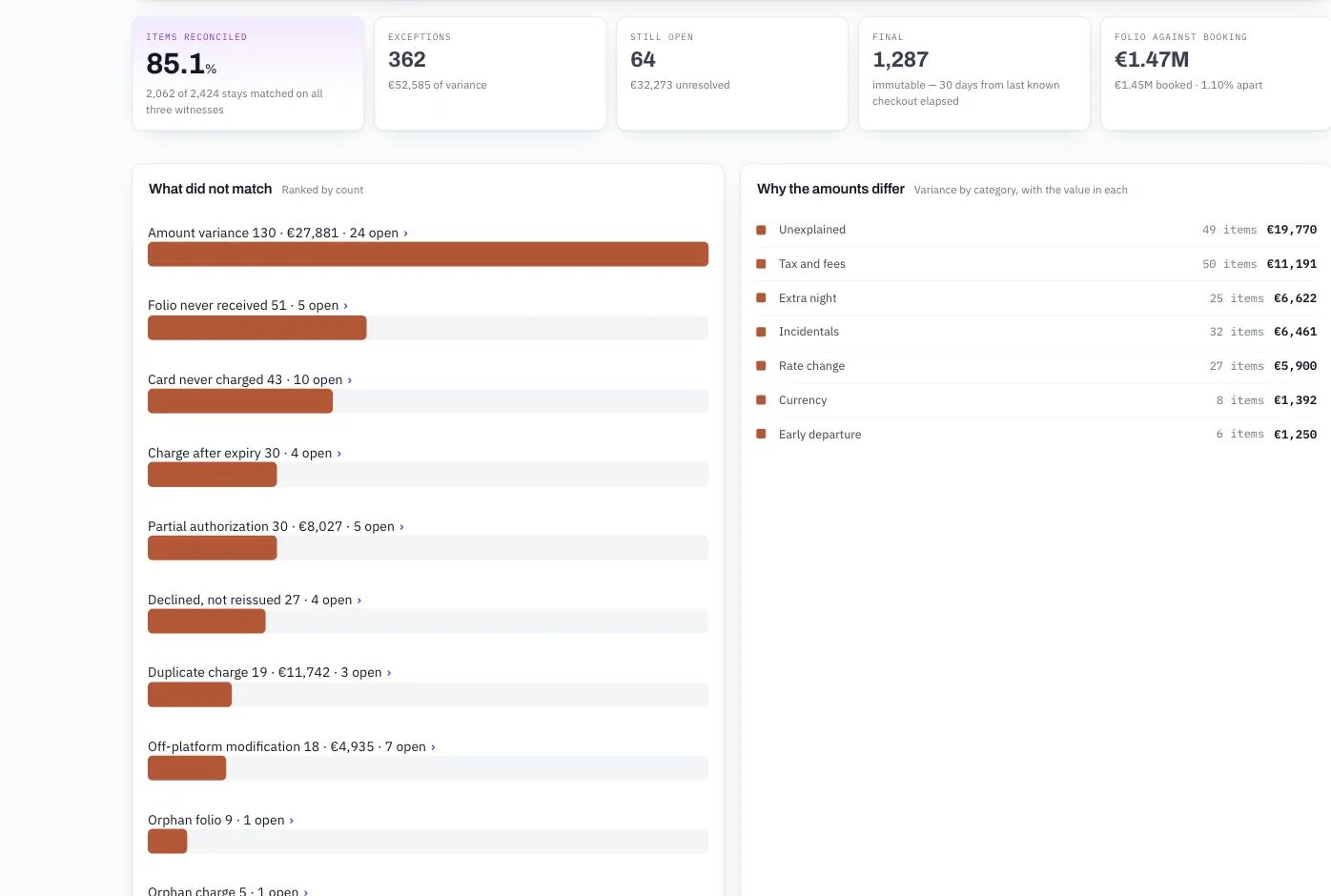
Reconcile booking, card, and folio data—and prioritize every financial exception.
Compare what was booked, what was charged, and what appears on the folio. Track reconciliation rate, total exception value, open exposure, final unmatched items, duplicate charges, missing folios, tax and fee variances, rate changes, currency differences, and other discrepancies in one finance review queue.
Reconciliation report
Matched and unmatched items across booking, card, and folio records.
Exception value
Dollar value of amount variances, duplicate charges, missing folios, and other discrepancies.
Open exposure
Unresolved value and item count requiring investigation or supplier follow-up.
Resolution progress
What is reconciled, still open, or final after the permitted review period.
04 / COMMERCIAL VALUE AND SAVINGS
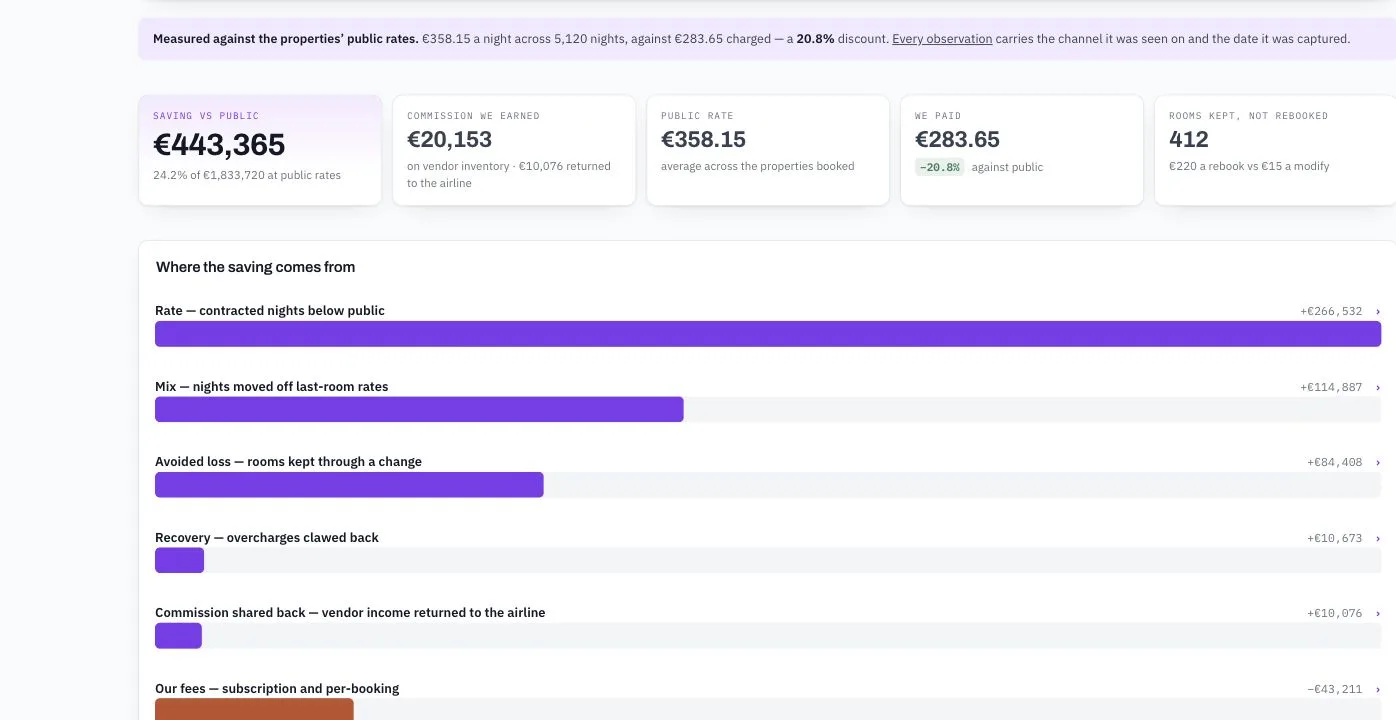
Measure savings, avoided loss, recovered overcharges, and supplier performance.
Show how contracted rates, sourcing decisions, schedule-change handling, overcharge recovery, and commissions contributed to financial value. Compare public rates with the amount paid and give Finance and Procurement evidence for supplier reviews, contract negotiations, and budget decisions.
Measured savings
Savings against observed public rates, with the comparison source and capture date retained.
Commercial performance
Contracted-rate benefit, sourcing mix, commission, and supplier-level results.
Value protection
Avoided rebooking cost and overcharges recovered through reconciliation.
Decision support
Evidence for supplier reviews, contract negotiations, forecasting, and budget decisions.
ONE VERSION OF THE TRUTH
A shared financial view for every team responsible for the outcome.
CFO and finance leadership
See financial position, material movement, and measurable program value without waiting for a custom analysis.
Financial control and accounting
Prioritize investigation, understand open exposure, and follow issues through to resolution.
Procurement and sourcing
Use consistent commercial evidence to guide supplier conversations and future decisions.
Crew operations
See how operational choices affect cost and where performance requires attention.
REPORTING COVERAGE
Financial reporting for the questions airline teams actually need to answer.
Move from a consolidated financial position to the supplier, station, booking, card, folio, or exception behind the number.
- How much did the crew accommodation program cost?
- What is our cost per booking and cost per room night?
- How much spend used contracted hotels versus fallback inventory?
- What did schedule changes, cancellations, and rebookings cost?
- Which booking, card, and folio records do not reconcile?
- What value remains open, disputed, or unresolved?
- How much savings, avoided cost, and recovered overcharge did the program generate?
- Which suppliers, stations, and exception types need attention?
FINANCE-READY EVIDENCE
The answer and the supporting evidence belong together.
Routespring helps teams move from a financial signal to the relevant operational and commercial context, without rebuilding the story across disconnected reports.
Operational activity
Financial control
Finance-ready evidence
See what financial control could look like for your operation.
Talk with Routespring about your crew-travel reporting needs and see how the platform brings financial and operational context together.