
Routespring operations guides
Airline travel financial operations: costs, credits and control
Understand crew travel spend, supplier billing, open exceptions and recovered credits, with practical financial operations guidance from Routespring.
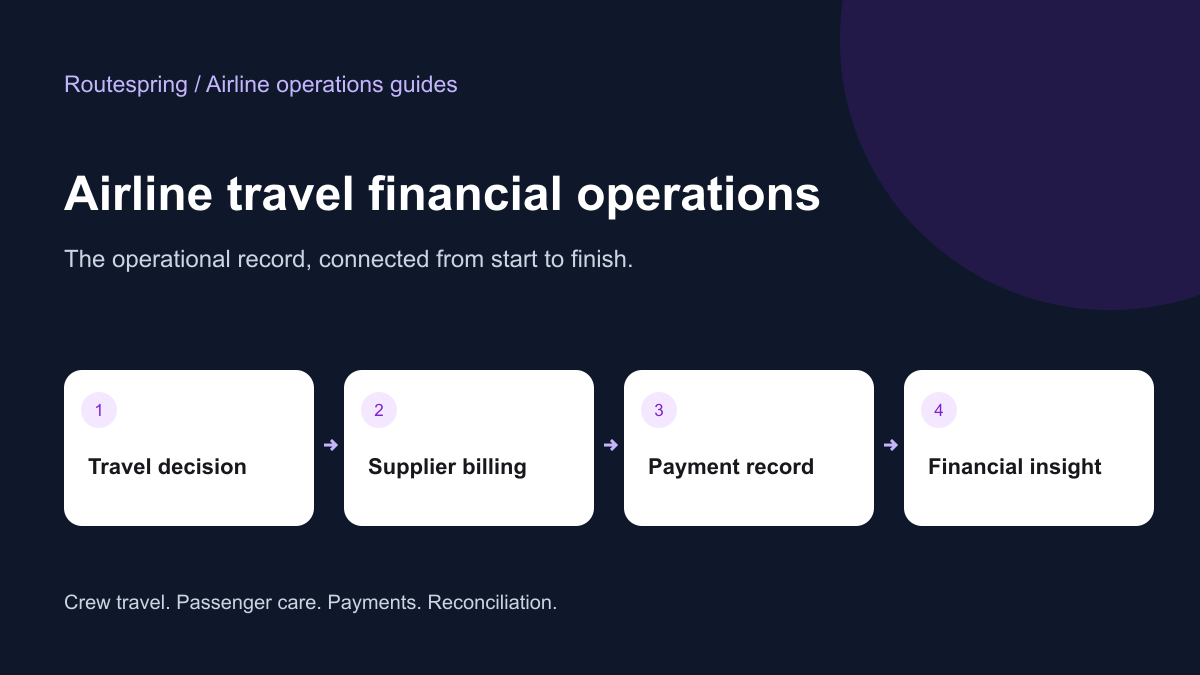
- 1Travel decision
- 2Supplier billing
- 3Payment record
- 4Financial insight
Airline travel financial operations connect crew travel decisions with supplier billing, payments, reconciliation and reporting. They help finance explain what was booked, what changed, what was charged and which credits or discrepancies remain open.
Routespring connects airline travel operations with centralized payments, ReconAI hotel folio reconciliation and financial reporting. The crew desk, procurement team and finance team can follow the same booking history from the stay through the bill.
For finance leaders, the value is practical: understand cost movement, prioritize unresolved amounts, measure supplier performance and separate identified savings from money actually recovered.
Use precise financial states
Booked spend is the value of agreed bookings at the selected reporting point. It may change with amendments, cancellations and additional charges. Authorized spend represents an approval or payment authorization; define which meaning the report uses.
Charged spend reflects recorded transactions. Invoiced spend reflects supplier billing, which can arrive on a different timetable. Settled spend reflects the completed payment or settlement state used by the finance process. State the treatment of refunds, credits and foreign exchange.
These figures can legitimately differ. A hotel may be booked this month, stayed next month and invoiced later. A cancellation may create a credit after a charge has already settled. Keep the dates and statuses needed to explain those timing differences.
Preserve the operational reference chain
Useful anchors include booking ID, property, stay dates, crew or group reference, station, flight or disruption reference, cost center, supplier document ID and payment reference. Capture the approved rate and the terms behind it, including inclusions and cancellation cutoffs.
Retain changes against the same booking story. An unexplained increase in cost is easier to investigate when finance can see the extra night, the revised arrival time and the approval. An export containing only the final total leaves the reviewer to reconstruct those decisions.
Agree which system owns each field and how conflicting records are resolved. A supplier’s stay date format and an airline’s operational date may differ. Document time zones and currency conventions rather than relying on visual similarity.
Make payment readiness part of operations
Centralized payments and booking-linked payment records help reduce personal-card use and give finance a clearer view of travel spend. The booking, covered charges and authorization details provide the context for both the property and the operations desk.
Make payment readiness visible before arrival: covered charges, authorization information, property acceptance and an owner for questions. When the hotel needs clarification, the desk can respond with the booking and payment context already connected.
Separate a payment instrument being issued from a property accepting it, a charge being made and the transaction settling. Those events belong in the reporting model when they affect readiness or reconciliation.
Define a small set of decision measures
Cost per occupied room night can be calculated as included accommodation cost divided by eligible occupied room nights. Define whether taxes, breakfast, transfers, cancellation charges and currency conversion are included. Booked nights and occupied nights are different denominators.
Contract utilization measures eligible room nights placed under the relevant contracted arrangement divided by the eligible room-night population. Define exclusions, such as stations without a contracted property or periods when contracted supply was unavailable.
Open exception value is the amount associated with unresolved financial exceptions under a stated valuation rule. Categorize missing documents, unmatched charges, disputed rates and credits awaiting receipt. An exception is not automatically a loss.
Reconciliation coverage should state the population and completion rule: for example, completed eligible stays with the required evidence reviewed, divided by all eligible completed stays by the reporting cutoff. An automatically matched row may still require review under the policy.
Credit realization tracks confirmed credits or refunds received against approved recovery claims. Keep claimed, agreed and realized amounts distinct.
Separate savings, avoided cost and recovery
Savings compare an actual outcome with an approved, comparable baseline. State the comparison period, service scope, currency basis and exclusions. A cheaper room farther from the airport may not be a saving once transfers and operational requirements are considered.
Avoided cost is an estimated charge prevented by an action, such as cancellation before a contractual cutoff. Retain the applicable terms and the basis for believing the charge would otherwise have occurred. Identify it as an estimate where appropriate.
Recovery concerns a correction, credit or refund for an amount already billed or paid. Record the realized amount and associated costs. Do not add an identified overcharge to recovered money before the supplier’s correction is confirmed.
Avoid counting the same value twice. A corrected duplicate invoice line should not appear in both procurement savings and recovered overcharges without a clear accounting rule that prevents double counting.
Worked example: explaining a month-end room-night variance
Assume a fictional event has 40 booked room nights, of which 36 were occupied, two were cancelled without charge and two remain disputed after a late schedule change. The supplier invoices 40 nights. A payment has settled, and the hotel agrees to review the two disputed nights.
The report should show the operational quantities, the invoiced amount, the payment state and the disputed exposure. It should not report four nights recovered merely because four were unoccupied. The cancellation evidence supports two no-charge nights; the other two require a decision under the applicable terms.
Once a credit is issued, match it to the original document and verify its financial outcome. Preserve the initial exception and resolution so the next supplier review can distinguish billing error from a valid late-cancellation charge.
Build an ERP handoff around the receiving process
Finance-ready data needs agreed fields, coding, currency treatment, document references, status and ownership. Confirm whether the handoff is a file export, a connector or another approved mechanism. Test rejected records and correction handling as well as the successful import.
Routespring connects booking, card and folio reconciliation with change-impact analysis and supplier performance reporting. Finance can follow the cost to its operational cause and give procurement or the crew desk a specific issue to resolve.
Agree the handoff around the receiving finance process: required fields, coding, references, review status and correction handling. A well-defined record reduces re-entry and gives the next team the information needed to continue.
Frequently asked questions
Why do booked, invoiced and paid totals differ?
They reflect different records and dates. Amendments, cancellations, taxes, extra services and later credits can change the amount. Reconciliation connects the records to establish what explains the difference.
What is open exception value?
It is the amount associated with unresolved financial questions under the reporting rule used. Examples include an unmatched charge, disputed rate or credit awaiting receipt. The review outcome determines whether it is a valid charge, timing issue or recoverable amount.
How should finance calculate cost per room night?
Divide the included accommodation cost by the eligible occupied room nights. State whether taxes, meals, transfers and cancellation charges are included, and use the same basis when comparing periods.
What is the difference between savings and recovery?
Savings compare an actual result with an approved comparable baseline. Recovery concerns a correction, credit or refund for an amount already billed or paid. Keep their evidence and calculations separate to avoid counting the same value twice.
How does Routespring help airline finance?
Routespring connects booking history, payment records, hotel folio reconciliation and reporting. Finance can investigate a charge with its operational context, prioritize open items and track corrections through their financial outcome.