
Routespring operations guides
Voice AI for hotel folio retrieval: how the workflow works
See how Routespring’s VoiceAI calls hotels for missing folios, coordinates email follow-up and connects supplier responses to hotel reconciliation.
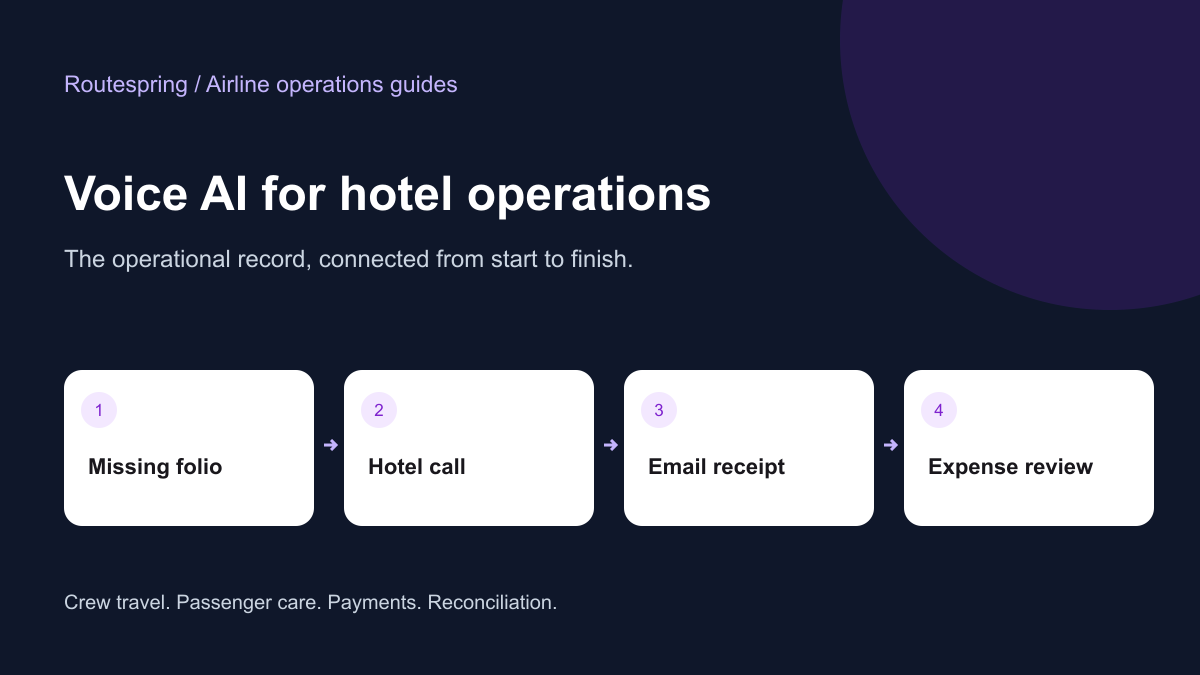
- 1Missing folio
- 2Hotel call
- 3Email receipt
- 4Expense review
Voice AI for hotel folio retrieval calls a hotel to request the itemized record of a stay, records the response and connects the follow-up to the booking. The aim is a usable folio received and matched to the correct stay, giving finance the detail it needs for reconciliation.
VoiceAI is the hotel communication agent within Routespring’s ReconAI workflow. It works with email follow-up and expense itemization so the hotel conversation leads into the financial review. For airline finance teams, crew travel desks and travel management companies, that means less repeated chasing and a clearer next step for every missing document.
Why the call needs booking context
A hotel may need the guest name, stay dates, confirmation number and an approved destination for the document. The request should be specific enough for the property to locate the stay and send the right document.
The workflow should also know whether another agent has already contacted the property, whether the supplier sent a document and whether that document was usable. Without shared context, Voice AI can repeat a request the hotel has already fulfilled or ask for the wrong revision.
Hotel phone systems add practical constraints. Calls can reach a central reservation team, front desk, accounting office or voicemail. The person who answers may not be able to issue the folio. Capture the actual outcome instead of reducing every answered call to success.
Give every hotel call a clear next step
A folio request should identify the stay and explain the document needed. If the hotel says it already sent the folio, check the agreed receiving channel. If the hotel needs accounting to respond, record that dependency and the expected next step.
A focused retrieval workflow gives the hotel a clear request and keeps the finance team informed. When the conversation raises a billing dispute, booking change or another decision, the relevant context moves with the case to the person responsible.
Define when the caller should stop and hand off: conflicting stay details, identity questions it cannot resolve, an unexpected payment request, a contractual dispute or repeated unsuccessful contact. Give the human reviewer the context and conversation outcome needed to continue.
Coordinate Voice AI with email
Phone and email should share one case record. Before another call, check incoming messages and attachments. After a call, record the result, the person or department reached where appropriate, the requested destination and the next permitted follow-up time.
Email intake then checks whether the attachment relates to the expected property and stay, whether it is readable and whether it replaces an earlier document. If the hotel sends an invoice summary when the task needs an itemized folio, the case remains open with a specific reason.
Routespring’s ReconAI workflow gives these responsibilities to coordinated agents: CompilerAI organizes tasks, VoiceAI handles hotel calls, EmailAI monitors and follows up by email, and ExpenseAI analyzes the received folio. The shared workflow is what connects a call to a financial outcome.
Handle four common exceptions
The hotel cannot find the stay. Check the reservation reference, date format and property identity before repeating the request. If the evidence conflicts, route it to operations.
The hotel says the document was sent. Check the receiving channel and matching logic. Do not create repeated supplier work because an attachment is waiting in an unprocessed inbox.
The document is incomplete. Record the missing page, itemization or revision needed. The next request should explain the gap clearly.
The hotel disputes the charge query. Separate retrieval from dispute resolution. Preserve the hotel’s explanation, supporting terms and the person authorized to decide the next action.
Worked example: from missing folio to expense review
Assume a fictional crew stay ended on Monday, and the folio is missing on the desk’s review date. The case includes the booking confirmation, stay window, hotel contact and previous email request.
Voice AI reaches the front desk, which says accounting will send the folio to the approved address. The case records “document promised; awaiting receipt.” When the attachment arrives, EmailAI associates it with the stay. ExpenseAI identifies room, tax and parking lines for review.
If parking appears to have been included under the applicable contract, that creates a separate billing exception. The retrieval task can be complete while the reconciliation task remains open. If no document arrives, the next follow-up is scheduled according to the agreed supplier-contact policy rather than triggered by an arbitrary repeat-call loop.
Design the conversation around how hotels work
A useful hotel call identifies the booking, explains the document required and gives the property a clear destination for its response. Keep the contact history with the request so the desk can follow up without asking the hotel to repeat the same information.
Include the situations hotel teams encounter every day: transferred calls, voicemail, different property departments and a request to speak to a person. A strong workflow handles these outcomes clearly and gives the desk a useful next step.
Give the operations team the conversation history it needs to continue the task, with appropriate access and retention for the information involved. Keep the handoff short, clear and connected to the booking.
Measure documents retrieved, not just calls made
Track the percentage of eligible missing folios received, time from first request to usable document, contacts per completed retrieval, duplicate contacts and human handoff rate. Define “eligible” and “usable” before reporting results.
Review incorrect matches and documents missed by intake, as well as call quality. Separate supplier non-response from system failure. A shorter call can still produce more work if it lacks the details accounting needs.
Evaluate Voice AI using the outcomes that matter to your desk: documents received, correct stay matches, follow-up effort and the time needed to complete reconciliation. Routespring’s workflow-based approach makes the conversation part of that larger operational result. Explore the hotel folio reconciliation workflow to see how retrieval connects to the rest of the review.
Frequently asked questions
What is VoiceAI in Routespring?
VoiceAI is the hotel communication agent within Routespring’s ReconAI workflow. It calls hotels for missing folios, follows up on requests and keeps the result connected to email receipt and reconciliation.
How does Voice AI work with email follow-up?
The agents share the stay and contact history. VoiceAI records the hotel’s response, EmailAI handles incoming folios and email follow-up, and the received document moves into itemization and review.
Which details help a hotel locate the right folio?
Use the property identity, guest or group reference, stay dates and booking confirmation, together with the destination for the document. Clear references help the hotel find the correct stay and reduce repeated requests.
What happens when the hotel says it already sent the document?
Check the receiving channel and booking match, then record whether the attachment is complete and usable. If another document is needed, the next follow-up should explain the specific gap.
What should an airline measure?
Measure usable folios received, correct stay matches, time to receipt, contacts per completed request and staff follow-up effort. These outcomes connect the call to the work the finance desk needs to complete.