
Routespring operations guides
AI agents for airline finance and operations: choosing the right workflow
Explore AI agents for airline finance and operations, from folio retrieval to invoice audit, and evaluate a workflow with Routespring’s 50-file test.
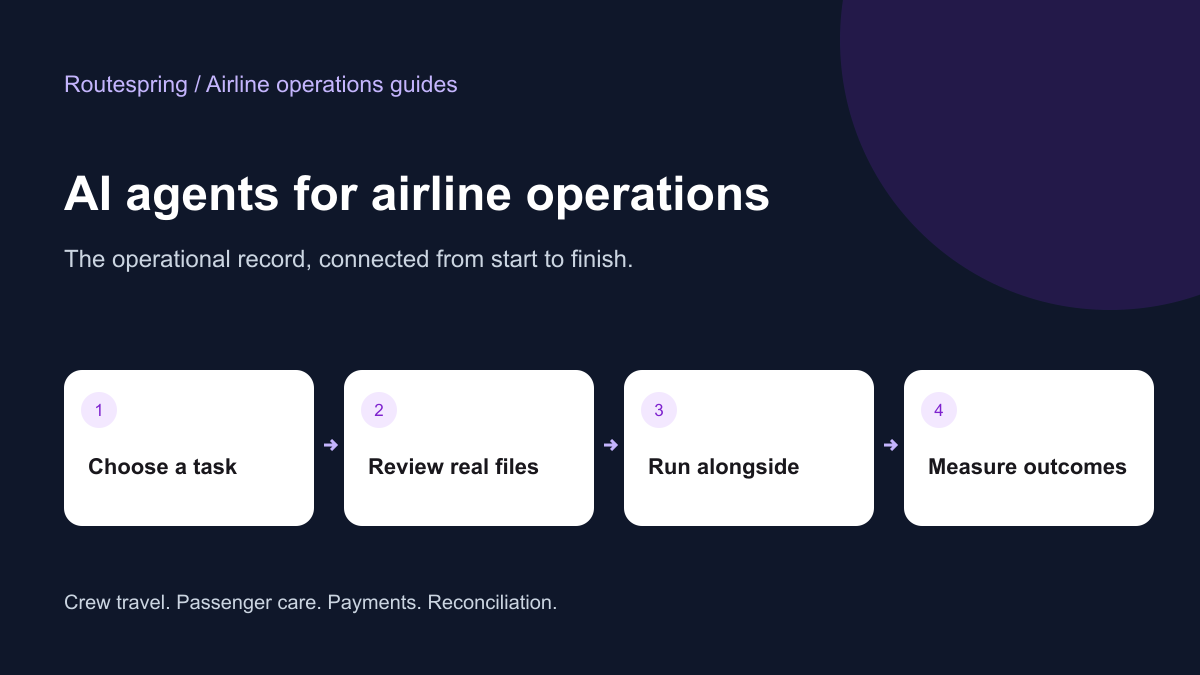
- 1Choose a task
- 2Review real files
- 3Run alongside
- 4Measure outcomes
AI agents for airline finance and operations take on defined tasks such as retrieving hotel folios, reviewing crew hotel invoices, organizing schedule-change work and preparing case outcomes. A useful agent connects the input records, the rules of the desk, the action and the result the next team needs.
Routespring Automation applies this approach to recurring finance and operational work. It starts with a real workflow and a 50-file evaluation, then compares the agent’s work alongside the team in shadow mode. Buyers can assess the task through its own records and outcomes.
For an airline leader, the first question is which repeated piece of work consumes time, loses financial value or creates avoidable handoffs. A focused workflow gives the team a practical place to start.
Choose the workflow with a clear business outcome
Hotel folio reconciliation starts with missing or inconsistent supplier documents. The outcome is the correct folio retrieved, charges itemized and billing questions ready for review. Routespring’s ReconAI connects this work through coordinated phone, email and expense agents.
Crew hotel invoice audit examines billing across room nights and supplier invoices. It brings booking and contract evidence to questions such as duplicated charges, unsupported nights or a credit missing from the account.
Unused ticket and credit recovery organizes the evidence behind value that could otherwise expire. Schedule-change queue work focuses on the servicing tasks created when travel changes. Agency debit memo and passenger compensation claim workflows organize the records and decisions needed to move those cases forward.
These tasks have different measures of success. Choose the problem that has a responsible owner, accessible records and a useful outcome the team can recognize.
Connect the agent to the way the desk works
A workable brief names the input, the decision rules, the action and the handoff. For a missing-folio task, the agent needs the stay reference, hotel details, prior contact history and destination for the document. Finance then needs a matched and readable record.
For invoice review, the relevant inputs include the booking history, invoiced room nights and contract terms. The team needs the reason a line was flagged and the supporting record, so it can decide whether to accept the charge or request a correction.
This approach makes automation concrete. The business owner can describe the work in operational terms rather than start with a model name or a broad promise to automate the department.
Use the 50-file test to establish the starting point
Routespring’s published method starts with 50 closed files from the selected workflow. These cases make the evaluation specific to the airline’s documents, decisions and operating rules.
Include a representative mix: routine records, missing information, amendments, duplicate documents and charges that look unusual but are valid. Have experienced reviewers establish the expected outcomes and resolve differences in interpretation.
The resulting comparison should explain which cases matched the expected outcome, which needed review and what caused a difference. That gives the owner useful evidence about the workflow and the next improvement to make.
Understand what shadow mode shows
Shadow mode means the agent runs alongside the operating team while its proposed outcomes are compared with the team’s work. It lets the owner observe performance on new cases before expanding independent handling.
Record the input, rule version, proposed outcome, supporting evidence and reviewer result. When work differs, identify the cause: document quality, a missing fact, a policy interpretation or a system handoff. The team can then improve the part of the workflow that created the issue.
Keep the examples used for development separate from independent evaluation evidence. Corrections are useful recurring checks and help the team see whether a problem returns after a change.
Measure effort, accuracy and financial value
For folio retrieval, measure usable documents received, correct booking matches, follow-up effort and time to completion. For invoice audit, track reviewed discrepancies, supplier decisions and credits or corrections confirmed.
For a recovery workflow, keep value identified, agreed and realized distinct. For processing work, include staff review and rework in the effort measure. This makes the comparison useful to the operational owner and finance leader.
A good evaluation also examines the cases that need specialist attention. The handoff should carry the records and decision context the person needs, so automation reduces repeated investigation as well as routine processing.
Expand from the strongest cases
Use the evidence to decide which routine cases the agent should handle and which decisions stay with the team. Different case types can progress at different speeds while sharing the same operating record.
Keep action permissions, confirmation and correction handling clear. An internal record update, supplier communication and a financial transaction have different completion evidence. The owner needs to see the result and the next action when something needs attention.
Ongoing review tracks outcomes after launch and brings corrections back into the workflow. This gives the team a practical way to maintain performance as documents, supplier behavior and operating rules change.
Why the connected workflow matters
Routespring combines experience in crew travel operations with finance and operational automation. The work around a stay already spans schedules, hotels, supplier communication, payment and reconciliation. Connecting those records gives an agent useful context and gives the next person a more complete handoff.
The broader opportunity is a travel operation in which a schedule change, passenger recovery or hotel charge remains connected to the work and financial outcome it creates. Start with one task, demonstrate its value and extend the connected process from there.
Frequently asked questions
What are AI agents for airline finance and operations?
They perform defined tasks using the records, rules and actions of an operational workflow. Routespring Automation addresses work such as hotel folio reconciliation, crew hotel invoice audit, unused ticket recovery and schedule-change queue processing.
Where should an airline start?
Choose a recurring task with accessible records, an accountable owner and a clear completion outcome. Missing folios or repeated invoice review often provide concrete cases to examine because the inputs and next action can be identified.
What is Routespring’s 50-file test?
It is the initial evaluation described in Routespring’s automation method: use 50 closed files from the chosen workflow to compare the agent’s results with reviewed outcomes. The comparison informs the next stage of the workflow evaluation.
What does shadow mode mean?
The agent runs alongside the existing team while its proposed outcomes are reviewed against the operating process. This shows how it handles new work and where the team should refine the workflow.
Must the whole travel program be replaced to discuss automation?
Start with the workflow and the records your team already uses. Routespring Automation’s public approach accommodates work in existing systems, so the conversation can focus on one finance or operations task rather than begin with a full travel-program replacement.