
Routespring operations guides
Passenger IROPS management: a guide to connected recovery
Manage passenger disruption cases, care, hotel arrangements and communications. Learn how Routespring connects recovery with financial follow-up.
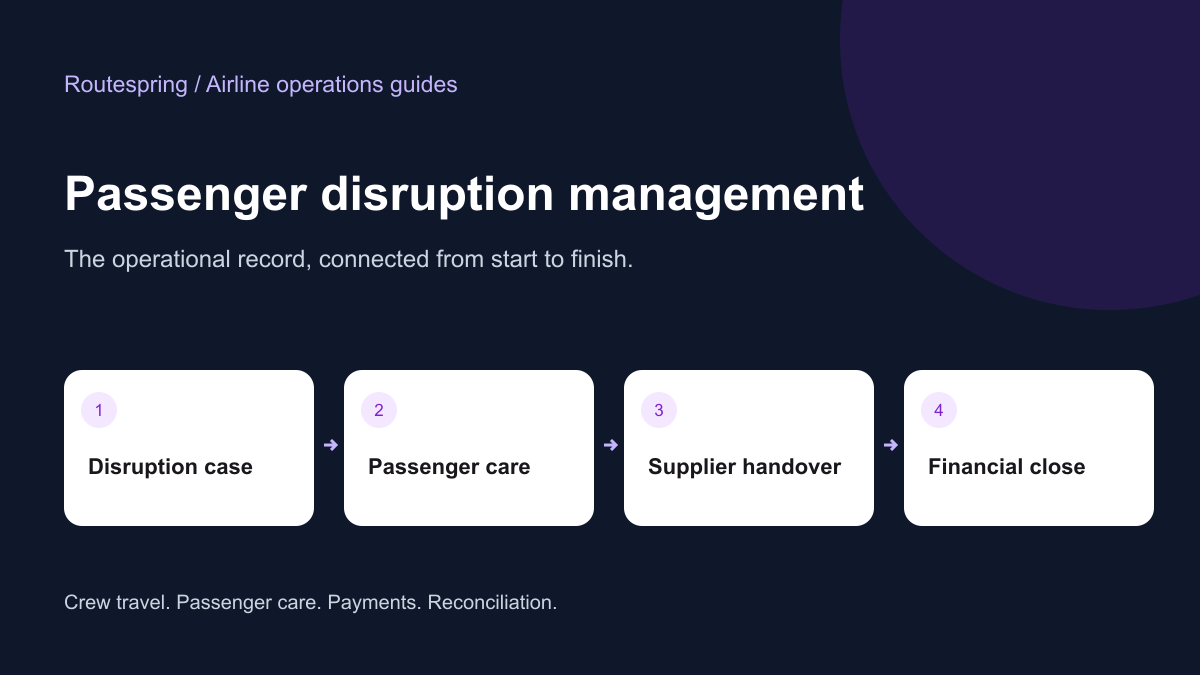
- 1Disruption case
- 2Passenger care
- 3Supplier handover
- 4Financial close
Passenger IROPS management coordinates the care and recovery work created by airline delays, cancellations and diversions. IROPS means irregular operations. The workflow connects the disruption case, affected passengers, care requirements, suppliers, communications and financial follow-up.
Routespring’s Passenger IROPS platform brings this work into one operating record for airlines, ground handlers and passenger logistics providers. Teams can retain existing suppliers, negotiated rates and booking channels while coordinating the case from intake through recovery.
The result is a clearer view of who needs care, which arrangements are confirmed, what changed and what the next shift or finance team needs to do.
Start with a clear disruption case
Create a case with the affected flight or event, station, dates and times, responsible airline or provider, current instructions and operational owner. Preserve changes as new information arrives. A diversion can change the airport, arrival time, available suppliers and transport plan.
Record what is known and what still needs confirmation. An initial estimate of passenger demand should not be presented as a validated manifest. Set a handover rule so the next shift can see the latest state without rebuilding the story from email threads.
Validate the passenger list and service requirements
Passenger records need enough information to support the agreed care process. Relevant fields may include identity references, contact details, party membership, onward journey requirements and assistance needs. Collect and expose only what each authorized role needs.
Resolve duplicates and mismatches before issuing arrangements. Keep families or other traveling parties linked where required. A room count calculated from a raw passenger total can be wrong if it ignores room-sharing rules, party composition or individual requirements.
The workflow should distinguish an unverified requirement, an approved service and a confirmed supplier arrangement. Those states help teams see which passengers still need action.
Apply care rules with a path for exceptions
Airline care policies guide the services, limits and approvals used in the operation. Bringing those rules into the case helps the team handle routine needs consistently and gives unusual circumstances a clear route for a decision.
Keep passenger care, reimbursement, refunds and compensation connected to the same event while preserving the decision process for each. Reviewed rules and clear approval responsibilities help the team respond consistently and retain the evidence behind the outcome.
Keep disputed facts visible. Delay causes, connection details and passenger circumstances can change the decision. Route uncertainty and matters reserved for legal or senior review to the assigned owner.
Source suppliers without losing the case history
Disruption teams may use contracted hotels, transport providers, meal partners and additional inventory. Record the supplier, service, quantity, rate basis, covered charges, relevant timings, confirmation and cancellation terms.
Routespring lets operators retain their hotel, transport and meal partners, negotiated rates and existing booking channels while recording the arrangements in the case. The Routespring booking workspace also gives the desk a place to explore additional sourcing options when demand exceeds its existing supply.
Keep supplier confirmation alongside the allocation so the next operator knows which arrangements are ready and which need follow-up. That visibility becomes especially valuable when a hotel changes a room block or an airline revises the passenger count.
Confirm the service the passenger can actually use
For a hotel, confirmation should cover room availability, the arrival window, occupancy requirements, covered charges and payment arrangements. For transport, identify pickup location, time, capacity and the responsible provider. For meals or other care, retain the agreed service terms and redemption instructions where applicable.
Suppose a hypothetical late-night cancellation affects a traveling party of three, including a passenger with an assistance requirement. The nearest hotel has a room available but cannot meet the recorded accessibility requirement. The operator needs an approved alternative and a coordinated transfer. Assigning any available room would leave the actual care need unresolved.
If the arrangement changes, revise the case and the affected passenger instructions together. The previous hotel address should not remain the latest message after a supplier change.
Track communications through failure and follow-up
A passenger update should explain the confirmed arrangement, next action, relevant timing and support route. The case should keep contact details, the latest arrangement and communication history together so the team can see who needs an update or follow-up.
A connected communication workflow keeps passenger instructions with the case: who needs an update, which arrangement it describes and what happened after it was sent. Agree the channels and fallback process around the airline’s operation so contact failures reach the right team quickly.
Plan the fallback before launch. Invalid contact details, failed delivery, no response and a passenger arriving at a different location need clear ownership. Keep airport or provider teams informed when they must complete the handoff in person.
Keep the flight recovery handoff visible
Alternative-flight recovery can involve connection needs, cabin, traveling parties, assistance requirements, fare limits and approvals. A proposed itinerary should retain those constraints and the current decision status.
Make servicing responsibility explicit as the recovery moves forward. The operator should see who will confirm the flight change, the ticketing outcome and the passenger update, with each handoff retained in the case.
Record the confirmed ticketing outcome and passenger update with the recovery. Where another team performs the servicing, retain its handoff and confirmation so the operator and next shift can see how the journey changed.
Close operations and finance with supporting evidence
Keep approved services, supplier confirmations, booking references, cancellations, unused allocations, invoices, payment records and disputes linked to the event. Record who approved extra costs and why.
Operational closure and financial closure can happen at different times. Passengers may have received care while supplier invoices or credits remain outstanding. Preserve those open items with their owners rather than declaring the whole event finished because the airport desk has handed over.
Review cost per defined unit, unresolved passengers, time to confirmed care, contact failures, supplier exceptions and billing variance. State whether the unit is passenger, party, room night or event, and which services are included.
Frequently asked questions
What is a passenger IROPS platform?
A passenger IROPS platform manages the casework created by delays, cancellations and diversions. Routespring connects passenger manifests, care requirements, suppliers, communication records and financial follow-up for airlines and passenger service providers.
Who uses Routespring Passenger IROPS?
Airlines, ground handlers and passenger logistics providers use the case workflow to organize disruption care, supplier arrangements, handovers and supporting financial records.
Can a provider retain its hotels and negotiated rates?
Yes. Routespring lets the operator retain its suppliers, rates and booking channels while recording arrangements in the disruption case. That brings visibility to the recovery while preserving existing commercial relationships.
How is passenger IROPS different from crew IROPS?
Passenger IROPS focuses on passenger care and recovery. Crew IROPS focuses on operational travel requirements for crew. The workflows can share event context while retaining the relevant policies, service needs and responsible teams.
How do care, flight recovery and compensation fit together?
Care arranges immediate services such as lodging or transport. Flight recovery addresses the onward journey. Compensation or refund decisions follow their own case rules. Keeping their records linked helps teams coordinate the event and its financial follow-up.